
Blog
Is It Worth Visiting Multiple Christmas Markets in Switzerland?
Is it worth visiting multiple Christmas markets in Switzerland — or is one enough? For travelers planning a December trip, this is a genuinely practical question, since Switzerland’s compact size and fast rail connections make it possible to see several markets in a single trip without the exhausting logistics that a similar tour would involve in a larger country. Zurich, Basel, Montreux, Lucerne, and Geneva each run distinct Christmas markets with their own character, from Basel’s medieval old-town setting to Montreux’s lakeside chalets facing the Alps, and the short distances between them mean a multi-market itinerary is often more realistic than it first sounds.
This guide compares the country’s major Christmas markets, weighs the case for visiting several against focusing on just one, and covers the practical side of stringing a few together in a single trip.
What Makes Switzerland’s Christmas Markets Different from Each Other
Part of what makes visiting multiple Christmas markets in Switzerland worthwhile is how genuinely different they are from one another, rather than being variations on the same format. Basel’s Christmas market, spread across Barfüsserplatz and Münsterplatz, sits inside a well-preserved medieval old town and is widely considered one of the largest and most atmospheric in the country. Zurich’s market at the main train station is unusual for being entirely indoors, centred around a large Swarovski crystal Christmas tree, while the city’s Niederdorf district and lakeside Wienachtsdorf market offer a more traditional outdoor setting nearby.
Montreux’s market runs directly along the shore of Lake Geneva with the Alps as a backdrop, giving it a scenic quality the more urban markets in Zurich and Basel can’t match, while Lucerne’s market combines lakeside chalets with the dramatic backdrop of the covered Chapel Bridge. Because each city’s market reflects its own setting and architecture rather than a standardised template, moving between them changes the experience meaningfully, which is the core argument in favour of visiting more than one.
The Case for Focusing on Just One Market
That said, visiting multiple Christmas markets in Switzerland isn’t automatically the better choice for every traveler. A single, well-chosen market — particularly a larger one like Basel or Zurich — offers enough stalls, food, and atmosphere to fill a full day or evening without needing to rush between cities. For travelers with limited time, especially those combining a market visit with other Swiss sightseeing, spending a full day at one market and pairing it with a mountain excursion or city tour can offer a more relaxed trip than a market-hopping itinerary that leaves less time for anything else.
Budget is a factor too: multiple train tickets, potential overnight stays in more than one city, and the general cost of eating and shopping across several markets add up quickly compared to a single well-planned day.
How Close Together Are Switzerland’s Main Markets?
The practical case for visiting multiple Christmas markets in Switzerland comes down to distance, and on this point the country has a clear advantage. Zurich and Basel are just over an hour apart by direct train, while Lucerne sits under an hour from Zurich in the opposite direction. Geneva and Montreux, both on Lake Geneva, are roughly an hour apart, meaning a Geneva-based trip can realistically add Montreux’s lakeside market as a half-day extension rather than a separate overnight stop.
This clustering means a single week-long trip based in one or two cities can reasonably cover three or four major markets without the long travel days that would be required in most other countries, which is a significant part of why a multi-market itinerary works better in Switzerland than it might elsewhere in Europe.
Building a Realistic Multi-Market Itinerary
A practical way to approach visiting multiple Christmas markets in Switzerland is to base a trip in one or two cities and treat the others as day trips rather than trying to change hotels every night. A Zurich-based stay, for example, allows for a full day at the Zurich station market and Niederdorf, a day trip to Basel for its old-town setting, and a day trip to Lucerne for its lakeside chalets and Chapel Bridge backdrop — all without needing to pack and repack luggage between stops.
On the western side of the country, a Geneva or Lausanne base works similarly for combining Geneva’s own market with a half-day extension to Montreux. Building the itinerary around a fixed base rather than a moving one tends to make a multi-market trip feel considerably less rushed, since evenings are spent back in familiar accommodation rather than adjusting to a new city each night.
What to Expect at Each Major Market
Basel’s market is generally considered the most atmospheric for its medieval old-town setting, with two main squares packed with wooden chalets, mulled wine stands, and local Christmas ornaments. Zurich offers the widest range within a single visit, combining the indoor station market with the open-air Niederdorf and lakeside Wienachtsdorf markets, making it a good choice for travelers who want variety without leaving the city. Montreux’s lakeside setting is the standout for scenery, with the market’s chalets strung along the Lake Geneva promenade against a backdrop of the Alps, while Lucerne pairs its market with one of the country’s most photographed landmarks in the covered Chapel Bridge.
Knowing these differences in advance makes it easier to decide which two or three markets genuinely add something distinct to a trip, rather than visiting several that end up feeling repetitive.
Getting Between Markets Without the Hassle
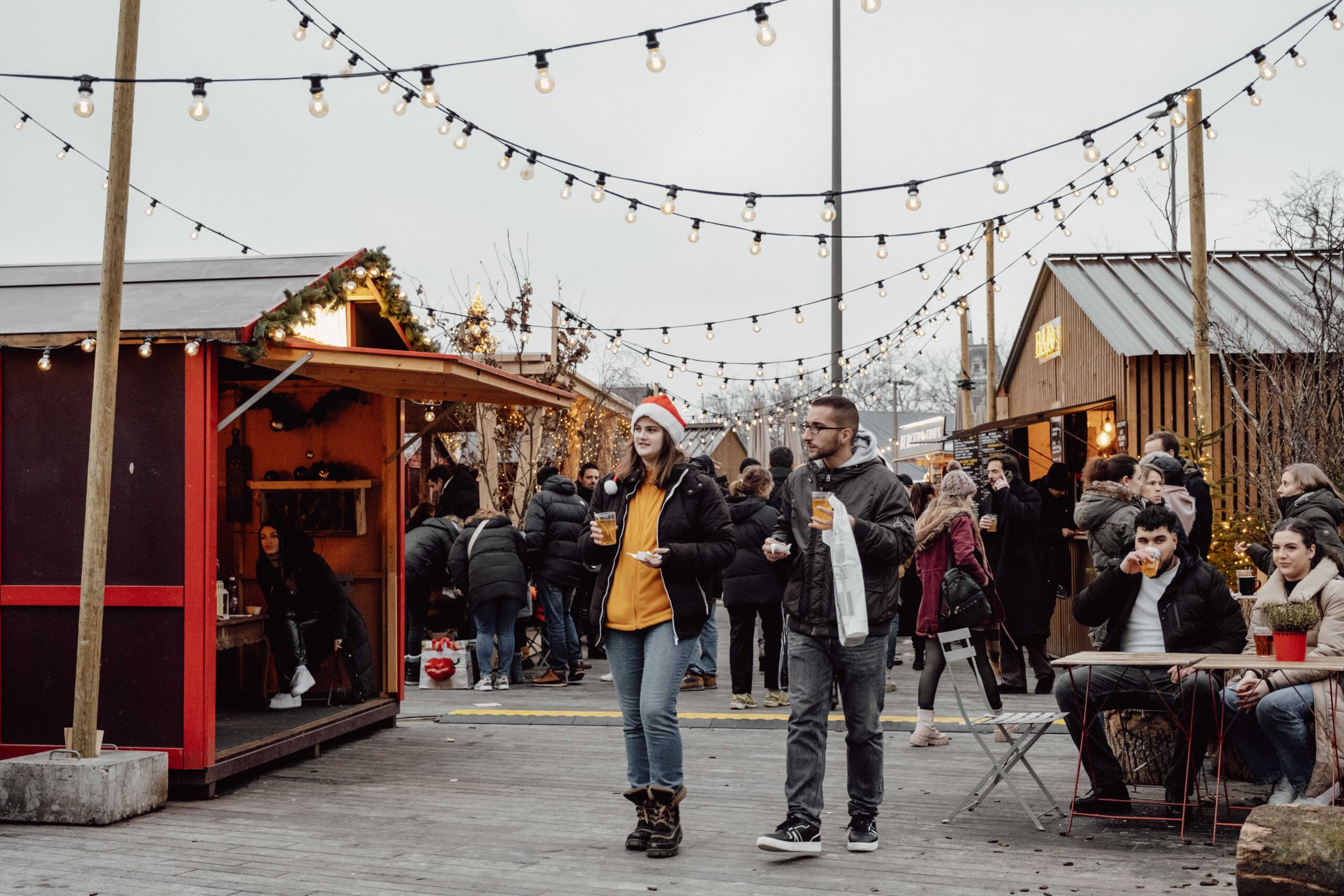
Switzerland’s train network makes moving between Christmas markets straightforward for most travelers, but December weather and the crowds around peak market season — particularly weekends in the two or three weeks before Christmas — can make train travel with luggage and shopping bags less comfortable than it sounds on paper. For visitors who want to see two or three markets without factoring in train schedules, station transfers, and connections, a private transfer between cities offers a direct, door-to-door alternative that removes the logistics from what should be a relaxed part of the trip.
This is particularly useful for evening market visits, when trains can be less frequent and taxis harder to find at Christmas markets’ peak closing times, making a pre-arranged private transfer a more reliable way to end the day.
Premium Private Chauffeur Across Switzerland
From scenic mountain tours to airport transfers and VIP events, enjoy custom luxury rides tailored to your itinerary.
FAQ: Christmas markets in Switzerland
Which Swiss Christmas market is the best to visit first?
Basel is often recommended as a first stop for its medieval old-town setting and large scale, while Zurich offers the most variety within a single city for travelers who want to see several market styles in one visit.
How far apart are Zurich and Basel's Christmas markets?
Zurich and Basel are just over an hour apart by direct train, making it easy to visit one as a day trip from a base in the other.
Can you visit Montreux's Christmas market as a day trip from Geneva?
Yes. Montreux is roughly an hour from Geneva by train, making it a realistic half-day or full-day extension to a Geneva-based trip.
Is it better to base a trip in one city or move between cities each night?
Basing a trip in one or two cities and treating other markets as day trips generally makes for a more relaxed itinerary than changing hotels each night.
Whether it’s worth visiting multiple Christmas markets in Switzerland comes down to how much time is available and what kind of trip is planned: for travelers with a week or so, the short distances between Zurich, Basel, Lucerne, Montreux, and Geneva make a multi-market itinerary genuinely rewarding, since each market brings a different setting and atmosphere.
For a shorter trip, one well-chosen market — paired with time for other sightseeing — can be just as satisfying without the added logistics. Either way, basing the trip around a fixed city and treating other markets as day trips tends to produce the most relaxed and enjoyable itinerary.


